

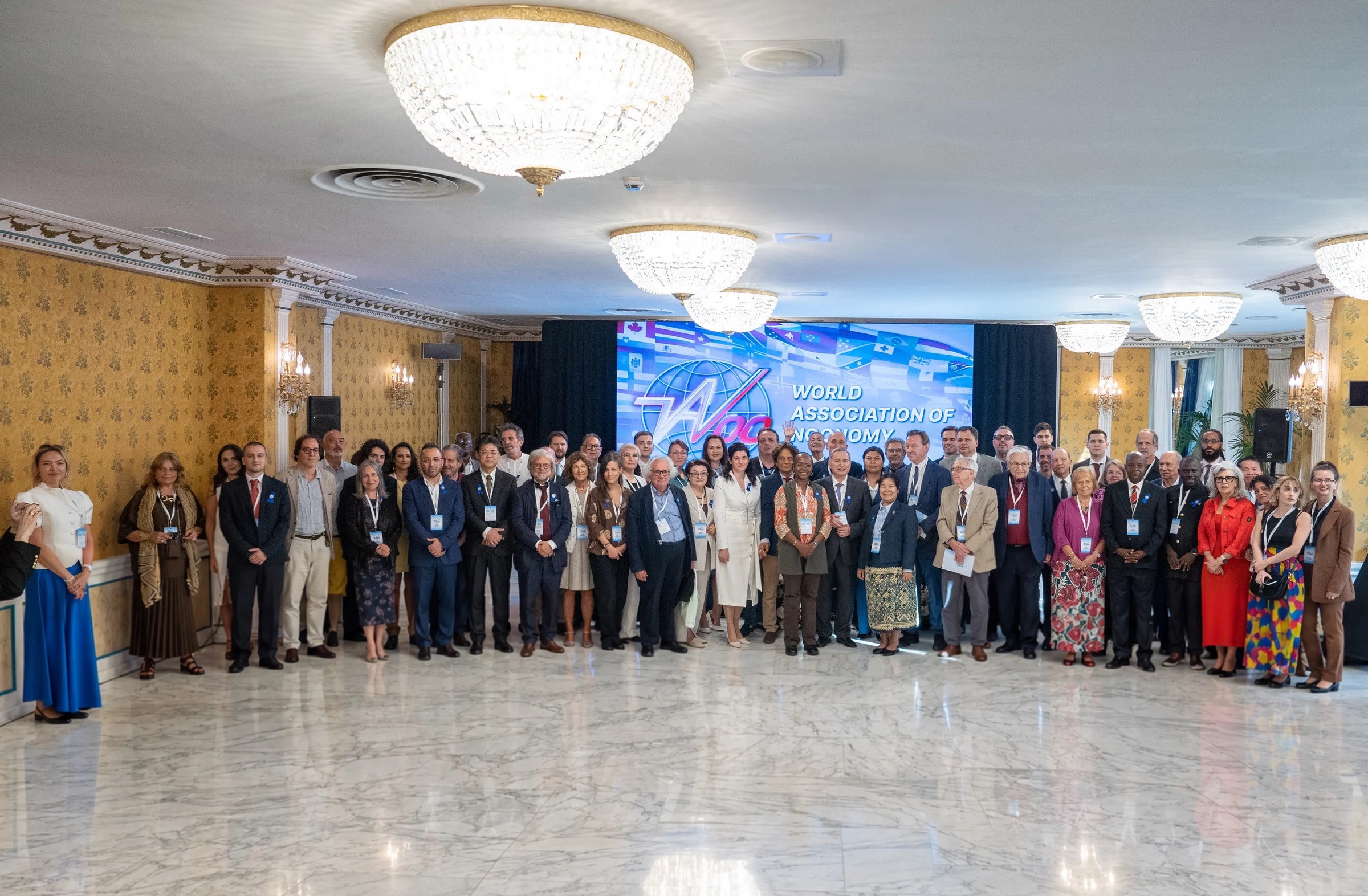
Global Congress of the World Association of Noonomy
On 17 September in Rome, the Global Congress of the World Association of Noonomy (WAN) opened, together with the international academic conference “The theory of noonomy: a new paradigm of civilisational development”.
The Congress brought together academics, researchers, public figures and experts from 37 countries to discuss fundamental questions of civilisational development.
Opening of the WAN Global Congress
Opening the Congress, Sergey Bodrunov, President of the World Association of Noonomy and President of the Free Economic Society of Russia (VEO of Russia), expressed confidence that the work of the Congress would make a significant contribution to the development of international academic cooperation and to the joint search for solutions to global problems and for ways of transforming the existing socio-economic system.
“Today, in an age of profound technological, economic and social transformation, an event such as our Congress has a particular value. And that value lies in the creative power of scholarly enquiry, which opens up new horizons for humanity. It is precisely in dialogue and constructive academic debate, which erases geographical boundaries, that a new system of coordinates is born, uniting minds for the sake of a common future,” Sergey Bodrunov noted.
On behalf of the World Association of Noonomy, Sergey Bodrunov expressed his gratitude to the heads of the relevant United Nations bodies who had sent their good wishes to the Congress: Li Junhua and Tatiana Valovaya, Under-Secretaries-General of the United Nations, and Pedro Manuel Moreno, Acting Secretary-General of UNCTAD.
Greetings were addressed to the participants of the Congress by Cheng Enfu, Chairman of the World Association for Political Economy (WAPE); Alexey Paramonov, Ambassador Extraordinary and Plenipotentiary of the Russian Federation to the Italian Republic; Vladimir Kuznetsov, Head of the UN Country Team in Russia; Alberto Bradanini, former Ambassador of Italy to the People’s Republic of China and to Iran, and others.
International academic conference “The theory of noonomy: a new paradigm of civilisational development”
Participants in the conference focused on the structural shifts associated with changes in the world economy and the acceleration of scientific and technological progress; on the transition from the neoliberal model of globalisation to a multipolar system; on overcoming the global challenges of our time, in particular the growing potential for conflict, environmental degradation and inequality between countries (in income levels and in access to education and technology); and on the search for a new paradigm of civilisational development.
Main plenary session
Delivering the plenary report, Sergey Bodrunov, President of the World Association of Noonomy, emphasised that the modern world stands at a bifurcation point.
“This is a world in which economic, cultural, environmental and political crises have converged within a single span of time. This is a phenomenon in the socio-economic system that we call a bifurcation point. At our Congress we shall examine the ways in which these crisis phenomena are developing, and those trends that could help to overcome the crisis,” said Sergey Bodrunov.
In the view of the academic, overcoming the bifurcation point and moving on to the next stage of civilisational development requires that pressing socio-economic problems be addressed in solidarity.
“The global problems we face cannot be solved alone — not by an individual, not by a group of people, and not by a single country. Most of these problems can be solved only within a framework of common, global and, I would emphasise, solidary governance of the process,” Sergey Bodrunov believes.
The President of the World Association of Noonomy added that the theory of noonomy offers a clear and comprehensible trajectory of civilisational development. The next stage is the transition from neoliberal society to the New Industrial Society of the Second Generation.
“In the New Industrial Society of the Second Generation, knowledge becomes the principal factor and driver of social production and the main basis for development. Social expenditure will go largely towards increasing the knowledge intensity of production and, accordingly, of the product. Under such conditions, new values take shape in society. Socialisation continues and leads to a situation in which the human being, taking part in self-acting production that nonetheless remains under human control and through which the entire material basis of social life is met, increasingly becomes a creator,” the academic said.
Reports were also delivered at the main plenary session by Alan Freeman, Co-Director of the Geopolitical Economy Research Group at the University of Manitoba; Cheng Enfu, Chairman of the World Association for Political Economy (WAPE); Svetlana Bodrunova, Head of the Centre for International Media Research and Professor at the School of Journalism and Mass Communications of St Petersburg State University; Sergio Bellucci, Academic Director of the Rome branch of the UN University for Peace; Carlos Ruiz, sociologist and Doctor of Latin American Studies; Vladimir Kvint, Head of the Department of Economic and Financial Strategy at the Moscow School of Economics of Lomonosov Moscow State University and foreign member of the Russian Academy of Sciences; and James K. Galbraith, Professor at the University of Texas at Austin.
The main plenary session was moderated by Svetlana Bodrunova, Head of the Centre for International Media Research at St Petersburg State University; Sergio Bellucci, Academic Director of the Rome branch of the UN University for Peace; and Eduardo Correa, Professor at the National Autonomous University of Mexico.
Work of the sessions
Three parallel sessions were held as part of the international conference “The theory of noonomy: a new paradigm of civilisational development”: “The noo-transition: global transformation, multipolarity, integration processes and strategies of socio-economic modernisation”; “The fundamental theoretical foundations of noonomy”; and “Creativity, education and culture as drivers in the formation of the noo-value core”.
Reports at the session “The noo-transition: global transformation, multipolarity, integration processes and strategies of socio-economic modernisation” were delivered by Alexander Shirov, Director of the Institute of Economic Forecasting of the Russian Academy of Sciences; Carlos Figueroa Ibarra, Professor at the “Alfonso Vélez Pliego” Institute of Social Sciences and Humanities of the Meritorious Autonomous University of Puebla; Alexey Gromyko, Director of the Institute of Europe of the Russian Academy of Sciences; Irina Novikova, Professor of the Department of Economic and Financial Strategy at Lomonosov Moscow State University; Nikolai Dmitriev, Deputy Director for Scientific and Methodological Work at the S.Yu. Witte Institute of Noonomy and New Industrial Development (INID); Stavros Mavroudeas, Professor of Political Economy at the Department of Social Policy of Panteion University; Phouphet Kyophilavong, Vice-Rector of the National University of Laos and Professor at the Faculty of Economics and Business Management; Pierluigi Orati, Head of Risk Management at Enel Reinsurance; Francesco Toscano, founder and editor-in-chief of the Visione TV channel and President of the Italian party Sovereign and Popular Democracy; and Giorgio Brera, First Secretary of the Milan section of the Italian political party Communist Party of Popular Unity.
The session “The noo-transition: global transformation, multipolarity, integration processes and strategies of socio-economic modernisation” was moderated by Alexander Nekipelov, Director of the Moscow School of Economics of Lomonosov Moscow State University, and Alexey Gromyko, Director of the Institute of Europe of the Russian Academy of Sciences.
Reports at the session “The fundamental theoretical foundations of noonomy” were delivered by David Lane, Emeritus Professor of Sociology at the University of Cambridge; Christos Papatheodorou, Professor at the Department of Social Policy of Panteion University; Edward Bbaale, Professor of Economics and Principal of the College of Business and Management Sciences at Makerere University; Peter Babyenda, Lecturer at the School of Economics of Makerere University; Ousavanh Thiengthepvongsa, Director General of the Socio-Economic Policy Research Institute (SPRI) of the Lao Academy of Social and Economic Sciences (LASES); Al Campbell, Emeritus Professor of Economics at the University of Utah; Leo Gabriel, Director of the Institute for Intercultural Research and Cooperation in Vienna; Eduardo Correa, Professor at the National Autonomous University of Mexico; Faustino Cobarrubia Gómez, Researcher at the Centre for World Economy Studies (CIEM) and Doctor of Economics of the University of Havana; and Alberto Lombardo, General Secretary of the Communist Party of Italy and Professor at the Department of Economics, Business and Statistics of the University of Palermo.
The session “The fundamental theoretical foundations of noonomy” was moderated by Sergey Bodrunov, President of the World Association of Noonomy, and Radhika Desai, Director of the Geopolitical Economy Research Group and Professor at the University of Manitoba.
Reports at the session “Creativity, education and culture as drivers in the formation of the noo-value core” were delivered by Keysone Chansina, member of the Standing Committee of the Science Council and Director General of the Office of the National Academy of Politics and Public Administration; Salvatore Izzo, editor-in-chief of the magazine Faro di Roma; Estefanía Ciro Rodríguez, Doctor of Political and Social Sciences of the National Autonomous University of Mexico; Natalia Yakovleva, Leading Researcher at the Institute of Economics of the Russian Academy of Sciences; Nadezhda Guevara Oropeza, Master of Constitutional Law and Human Rights; Giuseppe Lo Brutto, Director of the “Alfonso Vélez Pliego” Institute of Social Sciences and Humanities of the Meritorious Autonomous University of Puebla; Savvas Matsas, Professor at the Department of Communication and Media Studies of the National University of Athens; Tonny Mayambala, Researcher at the College of Business and Management Sciences, Makerere University; and Mehmet Adnan Akfirat, Chairman of the Board of the journal Belt and Road Initiative Quarterly.
The session “Creativity, education and culture as drivers in the formation of the noo-value core” was moderated by Natalia Yakovleva, Leading Researcher at the Institute of Economics of the Russian Academy of Sciences, and Katerina Kabakhidze, Head of International Relations at the S.Yu. Witte Institute of Noonomy and New Industrial Development (INID).

Closing plenary session
The closing plenary session approved the resolution of the Congress. The document points to the need to rethink established models of economic development and to devise fundamentally new approaches to shaping the future social order, moving towards a qualitatively different paradigm of social development based on the principles of solidarism and equality and on the tenets of the theory of noonomy.
The session also summed up the work of the sessions “The noo-transition: global transformation, multipolarity, integration processes and strategies of socio-economic modernisation” (moderator: Alexey Gromyko, Director of the Institute of Europe of the Russian Academy of Sciences); “The fundamental theoretical foundations of noonomy” (moderator: Sergey Bodrunov, President of the World Association of Noonomy); and “Creativity, education and culture as drivers in the formation of the noo-value core” (moderator: Natalia Yakovleva, Leading Researcher at the Institute of Economics of the Russian Academy of Sciences).
The closing plenary session was moderated by Sergey Bodrunov, President of the World Association of Noonomy; Leo Gabriel, Director of the Institute for Intercultural Research and Cooperation in Vienna; Margarita Ratnikova, Vice-President and Director of the Free Economic Society of Russia; and Sandro Teti, founder and head of the publishing house Sandro Teti Editore.
On the second day of the Congress (18 September), the Annual Assembly of the World Association of Noonomy and the formal opening ceremony of the WAN Institute of Noonomy took place, and the expansion of the network of Centres of Noonomy operating at universities and research organisations in various countries was announced. New centres will open this year in Beijing, Kampala and Bishkek.
The work of the Congress was covered by Russian and international media, including the Rossiya 24 television channel, the magazine Faro di Roma, the Cavallo di Fuoco portal and other media outlets.