

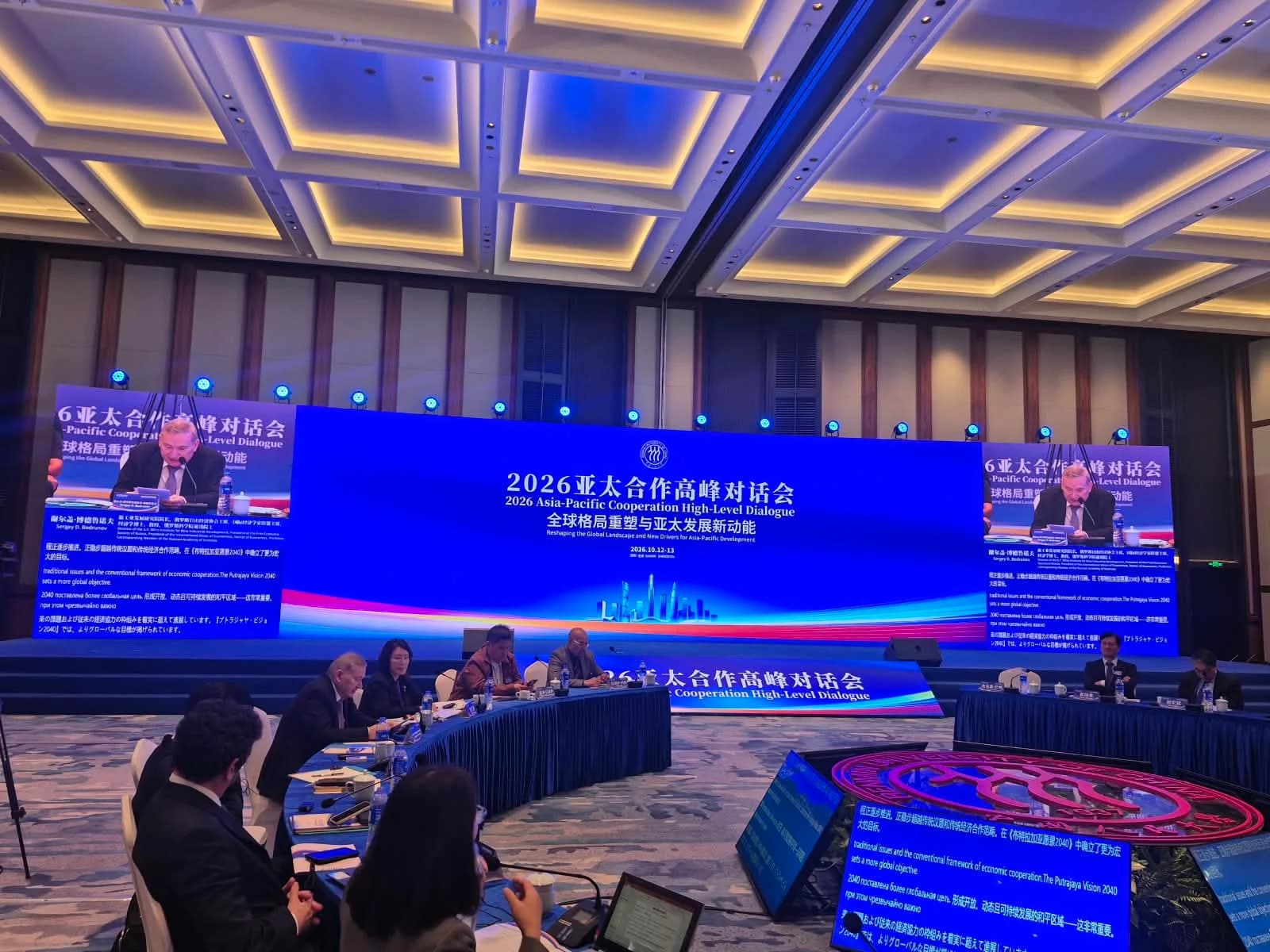
The academic conference “Dialogue of Leaders of the Asia-Pacific Economic Cooperation Countries 2026” has been held in Shenzhen, China. It opens the series of events preparing for the APEC Leaders’ Summit, to be held in Shenzhen in November 2026.
APEC is currently the largest grouping in the world. Its economies cover about 3 billion people, generate more than 60% of global real GDP and account for around half of global merchandise exports. Behind these figures lies the region’s vast industrial, scientific and technological potential.
The influence of APEC countries on developments in world trade is becoming ever more significant. It is also notable that APEC’s own agenda is gradually moving beyond the traditional issues of trade and investment cooperation. Over the past decade, topics related to the development of human potential and to global security have been included more and more actively. The Putrajaya Vision 2040, one of APEC’s main initiatives in recent years, and other APEC documents reflect a desire to develop relations between APEC countries in precisely this direction. These ideas are also taken into account in other documents proposed for discussion at the forthcoming APEC Leaders’ Summit.
Such global issues cannot be resolved without the participation of the major scientific forces of APEC countries. The international academic forum “Dialogue of Leaders of the Asia-Pacific Economic Cooperation Countries 2026”, held in Shenzhen, is an important stage in consolidating the academic community and in considering ideas and concepts that make it possible to find ways of addressing an important task. That task is to bring together the interests not only of the APEC region’s countries but also to define the place and role of the grouping in the global transformation of the world order that has begun.

One of the core concepts presented at the forum was the theory of noonomy proposed by WAN. WAN President Professor Sergey Bodrunov delivered a report on the significance and role of the theory of noonomy and the mechanisms it offers for solving global development problems. In his report, the scholar also drew attention to the need for synchronised development of knowledge-intensive technologies and of social narratives that take human development into account as the priority and goal of transforming the global world order. At the same time, Professor Bodrunov stressed, it is important to make the use of new knowledge-intensive technologies, in particular AI products and platforms, manageable. They should expand opportunities for meeting people’s needs, and such potentially dangerous technologies must not be used to achieve opposite ends.
The scholar thought it important to mention that, at the recent global AI4Peace forum on the development and use of AI at the Pontifical Lateran University (Rome), WAN presented an initiative to create a supranational body, modelled on the IAEA, to oversee the use of such technologies. WAN also proposed that the UN support this initiative within the framework of the scientific consultations of the APEC summit. The reason is that APEC has set itself the task both of developing AI as a priority of technological progress and of exploring the achievements of these technologies for peaceful, inclusive cooperation among the countries of the region. In doing so, it creates a zone of peace and managed development, which could become a starting point for expanding the implementation of peace initiatives around the world.
Professor Bodrunov noted, and many of the forum’s speakers agreed, among them representatives of almost all APEC countries and of other countries, that in 30 years Shenzhen, where the “Dialogue of Leaders of the Asia-Pacific Economic Cooperation Countries 2026” conference was held, has grown from a small village into a high-tech centre of 20 million people. Today the city has become an example of Chinese modernisation, in the society as well as in the economy. It can also be regarded as an example of the practical implementation of the principles and ideas of the theory of noonomy. In its basic aspects, that theory correlates with the principles of Chinese modernisation as the world enters the stage of forming NIS.2 (the New Industrial Society of the Second Generation) of the coming noo-transition. This correlation of approaches was studied at the recent Tongzhong Forum on Global Development in Beijing. The Tongzhong Forum also saw the opening of WAN’s tenth Noonomy Centre, devoted to research into global development problems and the training of humanities specialists.